


Press Kit
Book Praise
“A breathtaking, fresh, and ancient mystical biography of the world. A hypnotic weave of words and images leads us to that twilight place where history meets mystery, and tale meets truth. A tour de force where words find their place on the page with sacred inevitability.”
–Arundhathi Subramaniam, poet and author of When God Is a Traveller
“A truly remarkable book of angelic magic unlike any other. Transcending cultures and time periods, it should be read by anyone on the quest for truth.”
–John and Caitlin Matthews, authors of The Lost Book of the Grail
“A deep dive into a history of the world that seems more real than the received histories of victors, of ideologues and politicians. These are stories amplified by art; this is art responding to the depths of our common heritage. This book reminds us: we were stories before we came here, we are now acting out our stories, and we will be stories when we are gone. This one is to be read again and again, for each reading will bring new meanings and new illuminations.”
–Jerry Pinto, poet and author of Em and the Big Hoom, winner of the 2016 Windham–Campbell Literature Prize
“A book of magical and spiritual visions that awakens the reader’s sense of wholly other realities through the ancient and potent art of mythic storytelling. Read, dream, and be moved beyond the outer imprisonments of our time.”
–R. J. Stewart, poet and author of The Underworld Initiation
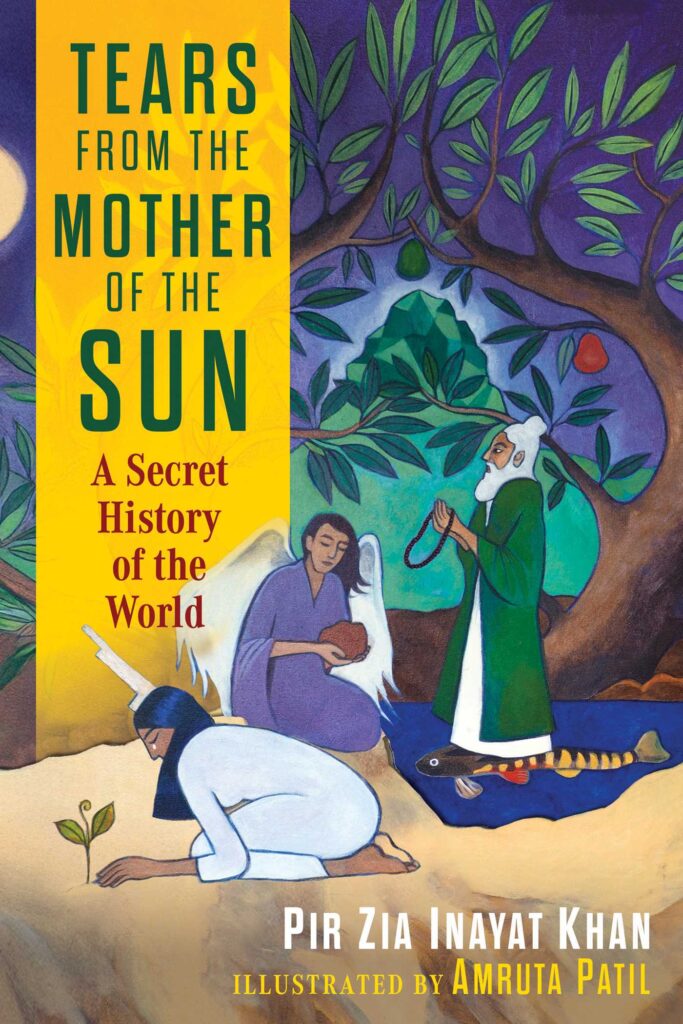
“Includes tears from Isis after Osiris’s murder, tears of Adam and Eve, and tears of Avalokitesvara among the many vessels of wisdom in this book. It etches more than sixty episodes marking spiritual heroes and heroines across time and space, from Persia to India to Egypt, with a glossary to help navigate the lofty tales and apt poems that grace its pages.” – Bruce B. Lawrence, Professor Emeritus of Islamic Studies at Duke University
Excerpts
The Hosts of Heaven
The angels were the first creatures. The foremost angels are called “the near ones.”* They have never ventured far from the old fountainhead. It’s difficult to distinguish them from the background against which they move; they hardly know themselves. They murmur “Holy, Holy, Holy,” and then fall into a silence that lasts eons.
The later angels roamed farther. In those days there was space but no land, ocean, atmosphere, or stars. And so the angels flew in the emptiness of the void. They still fly there. When they meet, they glide through each other. The frisson of their touch is something exceedingly strange. Think of a hand lighter than air touching another.
Unlike yourselves we wear no mask,
Hence from us comes the perfect kiss.
If anyone should ever ask,
Then tell them that our touch is this.
Marij
After the angels came the jinns,* my people. If angels are light, jinns are fire. But our fire is not the fire you know; ours is cool and smokeless. We call it Marij.* It’s the proverbial garden in the midst of flames.
The realm of the angels is called Jabarut.* Jinndom is called Malakut.* Malakut has as many climates as your material Earth. At its center, Mount Qaf rises up from the dense world below and ascends to Jabarut above, culminating in a resplendent peak known as the Emerald Rock.
Among the angels, strife is unknown. With jinndom it begins. We take the view that, for all their jarring dissonances, our elaborate polyphonies outshine the naive monophonies of the angels. Granted, the point is debatable. In any case, it’s in our world that problems begin. And with them, novel prospects.
In Heaven’s lanes pure peace prevails,
While lower down, discord appears,
Since wanderers on jinnic trails
Are prone to ardent hopes and fears.
Your Earth is an annex of the jinnic world, just as our world is a purlieu of the angelic realm. For many of our folk, your territory repels more than it allures. The sheer weight of matter poses a predicament for us. Be that as it may, there are those who are fascinated by the grit of it all. Venturesome jinns migrated to the Earth before humans appeared. They took on diaphanes*—ethereal bodies—and reveled in the gusts and gales of the nascent planet. They are known as elementals.*
Among the rocks, gnomes* play their games
While undines* swim in azure lakes,
And salamanders* crawl through flames
As sylphs* ride breezes through the brakes.
Of Angels and Elementals
For a long time the Earth was only sea and storm. Then land reared up and verdure spread. The weather calmed and animals found homes in every nook and crevice of the globe. The elementals likewise swelled. As their numbers surged, alas, a faction became obstreperous and noxious. They bludgeoned their prophets, Amir and Saiq. A delegation of angels was dispatched to quell them, and was met with outrageous violence. Thus began the war of the angels and the elementals.
An angel finer than thin air
Is still a consequential foe;
Angelic light, a thing so fair,
Can fast become a blinding snow.
In the end, the wayward elementals were subdued and treaties were signed. The war was over. But let me not omit a significant detail. During the conflict, a precocious elemental boy lost his parents and came under the protection of the angels. Raised in the heavens, he came to be known as Iblis. So faithfully did he serve Heaven that he was awarded a diadem encrusted with a hundred-angled fragment of the Emerald Rock.
The Clayling
The Diwan discussed a newly arrived directive. A lush garden had sprung up in Jinnistan, an oasis of unrivaled elegance. It was to serve as the place of inception for a new kind of being. The archangels were instructed to bring a portion of clay from the Earth.
Alert to what was afoot, Iblis preceded them. He approached the Spirit of the Earth and planted in her mind a seed of fear.
When Gabriel arrived, Earth refused to cede him a piece of her substance. Michael, coming afterward, fared no better. Then Azrael came. He soothed Earth’s trepidation and obtained the needed clay. Azrael’s light touch won him the assignment, henceforth, of taker of souls. Just as Azrael took our clay from the Earth, so he will return it one day.
This clay we wear is not our own,
Its owner is the spinning globe.
Our flesh and bones are but a loan,
A transitory borrowed robe.
In the Garden, the clay brought by Azrael was molded into a form. The likes of that form had never been seen. Still, all who inspected it found it oddly familiar. The hallowed breath of the One poured into the lungs of the effigy and it arose with a start. Thus was born the Clayling, the first human being.
Paradise
The Garden was a place of almost unimaginable loveliness. Four crystalline streams meandered between perpetually blossoming stands of frangipani, mimosa, and champak. Each morning, birds of incandescent plumage warbled exhilarating hymns to the dawn. When the sun reached its zenith, zephyrs wafted through the bowered groves, perfuming the air with heartravishing balsam. At night, shimmering rays streaming down from Sirius, Canopus, and Arcturus intermingled in traceries of breathtaking intricacy. If paradise was anywhere, it was here. For all that, the Clayling was lonely.
A rosy plum is nectarous,
But sweeter is your dimpled face.
These flowering vines are decorous,
But I prefer your arms’ embrace.
Seeing the need, the Deity split the Clayling in half. Where there had been one epicene individual, there now stood a contrastingly gendered pair. Adam and Eve, they were named. At the same moment, the Garden quietly transplanted itself from the soil of Jinnistan to the ether-sediment of the Earth.
A Fateful Choice
Two strange trees grew in the Garden. The first, the Tree of Life, bore an ivory-colored fruit. The second, the Tree of Knowledge, produced a fruit red as blood. Eve and Adam were duly warned not to eat the vermilion fruit. Somehow, however, it was destined for them.
Iblis sent a serpent to tempt them. In truth, little persuasion was needed.
Had they eaten the fruit of the Tree of Life, they would have slept and awoken in the heaven of Illiyin.* As it was, with fingers and lips stained red, they opened their eyes in the mundane world, the valley of toil. The idyll of the Garden had run its course.
Your eye may wander to a fruit,
But pause before you take a bite.
Straight down from glory runs a chute;
Reflect upon the exile’s plight.
To be sent out of the Garden was a shock and a blow. Earth’s stark horizons and gaping chasms suggested intimations of menace. Huddled in a makeshift shanty, Adam and Eve brooded long over what had been given to them formerly, and what they had done.
The tears the pair shed became puddles, then pools. Animals came to drink at these watering holes. Whenever they met the weeping couple, they offered their sympathy and encouragement. In deference to the animals’ reassurance, Eve and Adam ceased their lamentations.
Day by day, a peculiar flame grew within their hearts. It was a flame of contrition, but also of enduring hope. Most of all, it was the shining sign of a devotion to the Deity that was now unquestionably earnest and sincere.
One day Gabriel and Michael arrived with the news that all was forgiven.
Do not forever live in shame;
Repair the breach, ablute, and pray.
Believe in the Forgiver’s name;
Tomorrow is another day.
A great vision was then given to the pair. On a vast plain they saw an almost limitless assembly of people, displaying every imaginable cast of face, tone of skin, and length of limb. At the center of the throng was the indescribable presence of the Deity. A question now rang out: “Am I not your Liege?” Intense light suffused the atmosphere. Without exception, every voice in the multitude responded, “Yes.”
Angels inscribed the covenant on an olive leaf and sealed it inside a black meteor. To memorialize the momentous event, Eve and Adam built a house of worship with the Black Stone as its hallowed centerpiece.
Recent International Conferences and Invited Online Presentations
- Inayat Khan, Pir Zia, “The Water of Life in the Land of Darkness”, Bosnia International Sufi Conference, The Spring of Reflection: The Living One Who Sees Sarajevo, 9-13 April 2025.
- Inayat Khan, Pir Zia (Panelist), “Deepening an Understanding of Spirituality.” Global Spirituality Mahotsav, Hyderabad, India 2024.
- Inayat Khan, Pir Zia (Panelist), “Interreligious Dialogue”, Mind & Life Summer Research Institute at Garrison Institute, Garrison, NY, USA, June 2024.
- Inayat Khan, Pir Zia, “Turning Toward the Heart”, Science and Nonduality (online), October 5, 2024.
- Inayat Khan, Pir Zia (Panelist), “Interfaith Panel on Where Olive Trees Weep”, Science and Nonduality (online), June 2024.